
World War 2 walking tour: discover the resistance, daily life and liberation stories of the german occupation in Paris
- Book a tour
- WWII tour: resistance, liberation and occupation in Paris
- 2,5 hours
- 1st and 2nd arrondissement
- Small-group or private
- 5/5 (300+ reviews)
- Details
Available as a small-group walk or a private experience, this WWII tour in Paris explores four years that changed the city. It follows the German invasion of France in 1940, the daily realities of occupation, the persecution and deportation of Jews, the choices of collaboration and french resistance, and the Liberation of Paris in August 1944.
Why choose this World War 2 tour in Paris?
World War II in Paris can feel overwhelming: the German military presence, Vichy France, collaboration, the Resistance, antisemitic persecution, deportation, and the Liberation all overlap.
This guided tour gives you a clear framework that should match all your expectations. Rather than jumping between unrelated stories, we follow the development of the Occupation of Paris step by step:
- June 1940: the fall of France and the arrival of German troops in Paris
- Everyday life under occupation: food shortages, curfews, censorship, and fear
- The anti-Jewish policies of the Vichy government and Nazi Germany
- Resistance, repression, arrests, and collaboration
- The uprising and Liberation of Paris in August 1944
- How Paris has chosen to remember this history today
You will leave with a coherent understanding of what happened in Paris, and why the period still matters.
The walk takes you through the Concorde and Vendôme area and the streets around the quartier Sainte-Anne.
Along the way, we connect the wider history of occupied Paris to specific buildings, public spaces, and individual experiences, including the iconic Eiffel Tower.
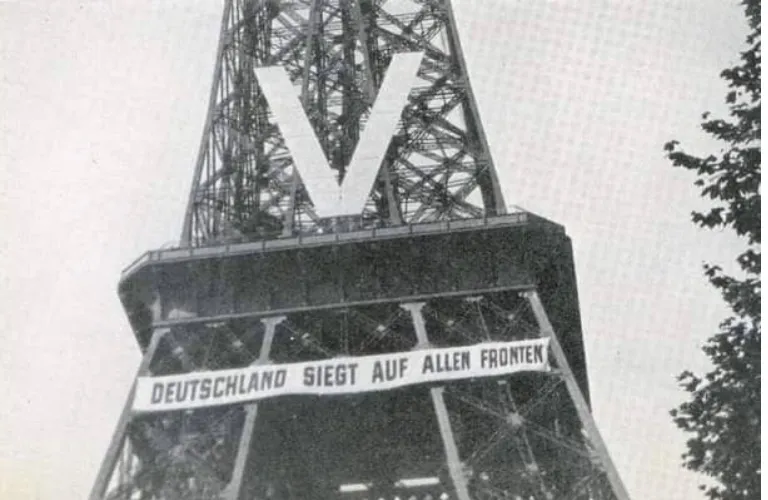
What will you see on this WWII walking tour?
The tour combines a clear historical framework with insights into the impact of WWII on Parisian life. It includes detailed stories about specific people, places, and events.
If you are new to the subject, the context helps you understand each story and how it fits into the wider history of occupied Paris.
If you already know the period well, these accounts offer opportunities to deepen your knowledge, while the chronological approach provides a useful refresher on the broader context.
The Concorde and Vendôme area: power and occupation
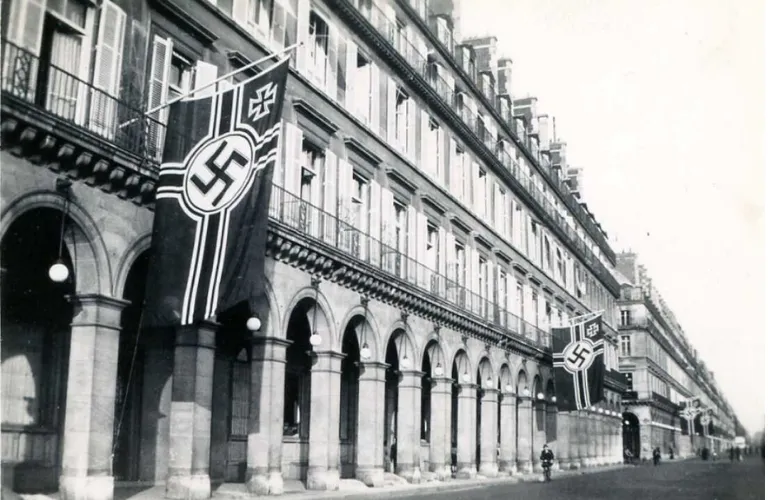
Around Place de la Concorde, Rue de Rivoli, and Place Vendôme, the setting raises an important question: how did the German occupation change the use of some of the city’s most prestigious buildings?
We explore the presence of German command centers and the contrast between the privileges of the occupying authorities and the restrictions imposed on the population. These streets provide a starting point for understanding how military power became part of the everyday landscape of Paris.
The quartier Sainte-Anne: persecution, resistance, and liberation
In the streets around the quartier Sainte-Anne, the focus shifts toward individual experiences: the persecution of Jewish families, acts of resistance, repression, and the fighting during the Liberation.
Rather than treating these subjects as separate chapters, we consider how they unfolded within the same city, and sometimes within a few streets of one another.
Who had the power to make decisions? What choices were available to individuals? And how did those choices change as the war progressed?
Reading the traces that remain
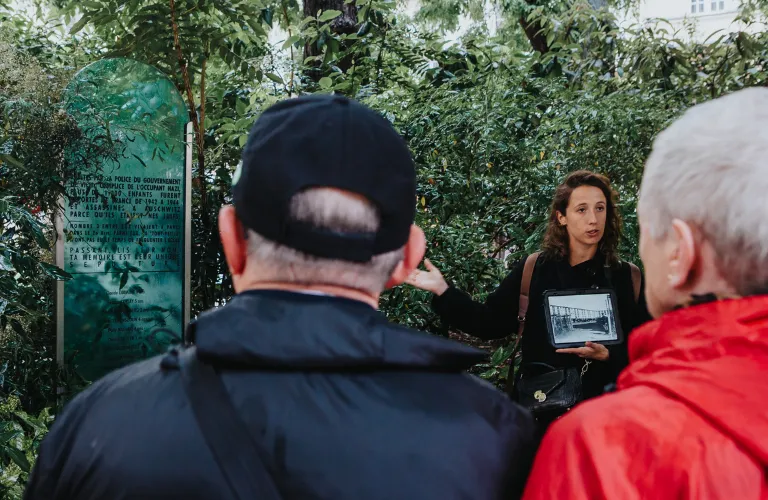
Historical photographs help connect the Paris you see today with the city under occupation. They provide a way to compare familiar streets with their wartime appearance and understand what has changed.
The walk also considers how this history is remembered. A commemorative plaque can tell us who is honored and what happened at a particular address.
It can also prompt further questions about the people and events that are less visible in the streets today.
What makes this tour different?
An itinerary and a clear timeline, connected to individual stories
Whether you know the broad outlines or are discovering the nazi occupation for the first time, the tour gives you a clear framework.
We start with a refresher on the context of France’s entry into the war and its swift defeat in June 1940, told by a Frenchwoman, allows you to discover a new perspective on those events.
The tour proceeds logically, without jumping from one period to the next. You’ll see how each event, big and small, influences the next, right up to the Liberation of Paris from WWII occupation.
How Paris dealt with the occupation history
A tour of WWII Paris would not be complete without a deeper understanding of Paris and France up until the end of the 20th century.
The tour also considers how France has remembered the Occupation since 1945: the celebration of resistance, the difficult acknowledgment of collaboration, and the memorials dedicated to the victims., and the place of the Shoah in public memory.
Meet your guide
A tour guide with a specialist focus on WWII Paris
Margaux is a Paris-born guide specializing in the history of Paris during World War II, particularly the Occupation, the persecution of Jews, the Resistance, and the Liberation.
She has guided more than 1,500 visitors through Paris and have developed a large online audience for her historical work, with more than 27,000 followers on Instagram.
Her content and tours are based on careful research, archival material, historical photographs and videos, and the physical traces that remain in the city.
On a private WWII tour, she’ll adapt the walk to your level of knowledge.
What guests say
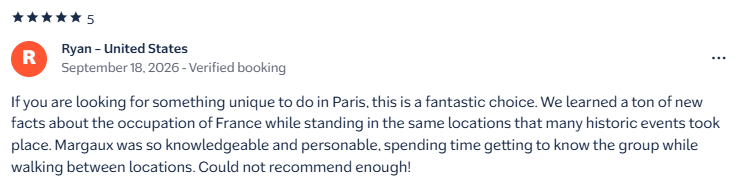
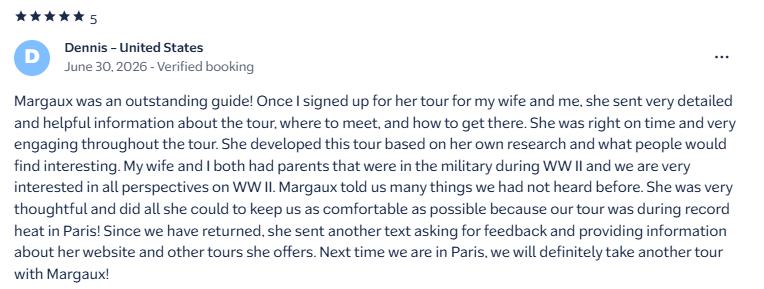
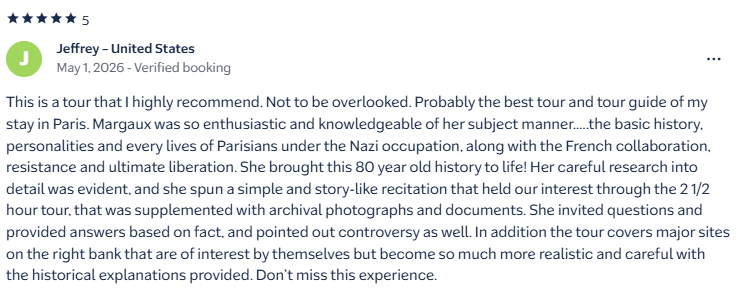
The visitors who participated praised the knowledgeable guide and say on-site photos and clear stories bring WWII Paris to life.
Practical information for your WWII walking tour in Paris
Should you choose a private or small-group guided tour?
Both formats explore the history of occupied Paris through a guided walk. The main differences are price, flexibility, and whether you prefer to join other visitors or have a guide just for your party.
A small-group tour is generally the more affordable option. You share the guide’s time with other visitors and follow a planned itinerary, exploring the subject alongside people with different interests and levels of knowledge.
A private tour usually involves a higher total cost, but gives us more flexibility to adjust the emphasis of the discussion. You may want a clear introduction to the Occupation, or you may already know the chronology and prefer to spend more time on particular events and individual stories.
When inquiring about a private tour, tell me how many people will be joining, what interests you, and whether anyone in your party has walking or standing limitations. We can discuss the options and price before you book.
Practical information
he visitors who participated praised the knowledgeable guide and say on-site photos and clear stories bring WWII Paris to life.
- Tour length: 2,5hrs
- Walking distance: 5km
- 1st and 2nd arrondissement
- Language : English or French
- Small-group or private
- 5/5 (300+ reviews)
Contact Us
- Your questions?
Frequently Asked Questions
Yes. You do not need prior knowledge of French or World War II history. The tour begins with the essential context and builds the story clearly as we walk.
Yes. The tours can work very well for children, provided they are comfortable walking for about one hour.
The guide makes an effort to include younger visitors by inviting them to participate, look closely at historical photographs, and ask questions along the way.
Teenagers are also welcome. Their experience will naturally depend on their interest in the subject, but they are encouraged to engage with the stories and documents discussed during the tour. In all cases, children should be able to walk for approximately one hour without difficulty.
In normal Paris weather, rain is usually manageable, and the tour goes ahead as planned. It is a good idea to bring an umbrella and suitable shoes.
In the unlikely event of force majeure—such as a natural disaster—or if a political event or demonstration makes the route unsafe or inaccessible, you will be notified in advance and offered a refund. This applies to bookings made directly; bookings made through third-party platforms, such as Viator or Tripadvisor, are subject to the platform’s own cancellation and refund policies.
The subject includes antisemitic persecution, arrests, deportation, repression, and violence. These topics are addressed soberly, with historical context and respect. The tour does not sensationalize suffering, but it does not avoid difficult realities.
On a private tour, I can adapt the emphasis to your interests. Small-group tours follow a shared itinerary, with time for questions throughout.
If it’s a small-group tour : A small-group format leaves time for you to ask questions, share details that feel important to you.